
Yen Weakness Nears Inflation Red Line: Bank of Japan May Be Forced to Hike Early


Original Title: "Yen's Sharp Drop Forces Central Bank to Consider Early Rate Hike? Report: Officials More Concerned About Weak Exchange Rate's Impact on Inflation"
Original Author: Yeh Huiwen, Wall Street News
Bank of Japan officials are increasingly focused on the potential impact of the weak yen on inflation, a trend that could substantially disrupt the future rate hike path. According to sources familiar with the matter speaking to Bloomberg, while the Bank of Japan may keep rates unchanged at the upcoming policy meeting, exchange rate considerations may prompt a reevaluation of the timing of the rate hike, potentially even forcing an earlier action.
According to Bloomberg, Bank of Japan officials believe that the influence of the weak yen on prices is strengthening, especially as companies are increasingly inclined to pass on rising input costs to consumers, leading to further inflationary pressures. Despite the Bank of Japan having just raised its benchmark rate last month and not set a predetermined rate path, if the yen continues to weaken, policymakers may consider bringing forward the previously anticipated rate hike.
Currently, the general expectation among private economists is that the Bank of Japan will raise rates at a pace of approximately once every six months, implying that the next action could take place in the summer of this year. However, sources speaking to Bloomberg indicated that officials are inclined to act promptly on policy adjustments rather than being overly cautious, indicating variability in the market's previously expected rate hike pace. In response to this news, the yen to dollar exchange rate briefly dropped to around 158.68 before rebounding to 158.33. As of the time of writing, the yen against the dollar had fallen to 158.55.
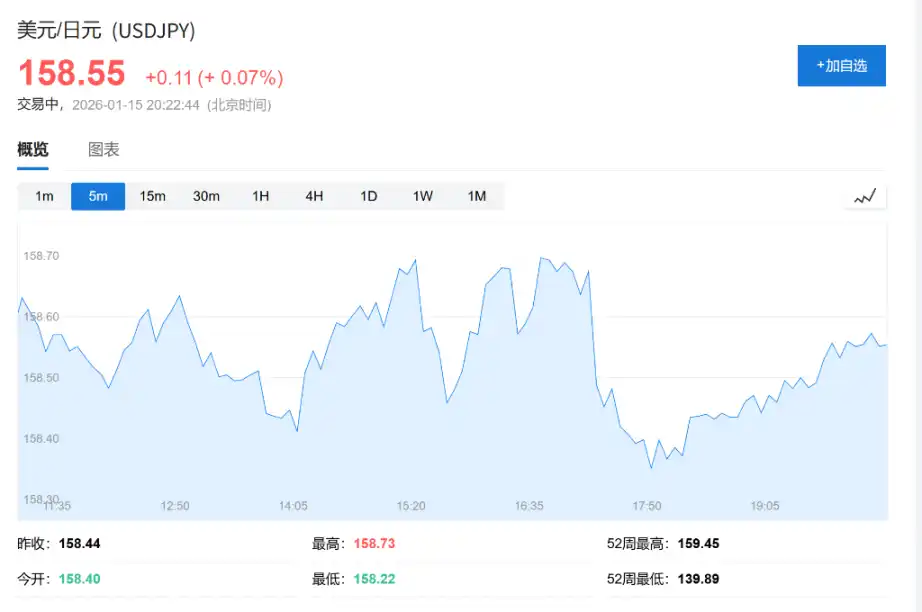
January Meeting Expectation: Maintain Rates
The Bank of Japan is set to announce its latest policy decision on January 23. Sources familiar with the matter told the media that officials' current view is that keeping the rate at 0.75% is appropriate, a level that has reached a three-decade high. While the overall inclination is to hold steady, the committee will continue to monitor economic data and changes in the financial markets until the last moment to make the final decision.
The focus of this meeting will be on how the central bank assesses the yen's impact on potential inflation. Sources told Bloomberg that given the inflation trend is nearing the central bank's 2% target, officials will closely watch how exchange rate fluctuations alter household and business price expectations.
Exchange Rate Transmission Mechanism in Focus
A yen devaluation typically increases inflationary pressure by raising import costs and also boosts exporters' profits. However, some officials pointed out that as the yen continues to weaken, its negative impact on the economy may be growing. Officials believe that the Bank of Japan still has room to continue raising rates, with the key being to seize the timing of policy adjustments.
The voice of the Japanese business community on the exchange rate issue is also becoming increasingly frequent. Yoshinobu Tsutsui, President of Keidanren, Japan's largest business lobbying group, made rare comments this week, calling on the government to conduct currency intervention to prevent excessive depreciation of the yen, describing the recent yen trend as "a bit overdone."
Market Background and Political Factors
Despite the Bank of Japan raising interest rates on December 19, the yen continues to maintain a weak position against the US dollar. Influenced by the news that Prime Minister Takaichi Sanae will hold a snap election next month, the yen slid further this week to a new 18-month low.
Bloomberg data shows that the 10-year average exchange rate of the yen against the US dollar is 123.20, while over the past two years, the yen's exchange rate has fluctuated between approximately 140 and 161.95. Although it touched an 18-month low earlier this week and saw a slight rebound with intensified warnings from monetary authorities, the overall depreciation trend continues to exert sustained pressure on the central bank's decisions.
You may also like

Argentina vs Cape Verde: When a Record-Breaking Legend Meets an Unbreakable Underdog
WEEX exclusive pre-match analysis of Argentina vs Cape Verde, exploring Messi-led Argentina’s dominance and Cape Verde’s historic defensive breakout, with a breakdown of volatility, structure, and match dynamics.
How does Gate redo "buying and selling stocks" from the cryptocurrency world to the stock market?
Former ByteDance employee's account: How I started with two Pinduoduo hard drives and made six times the profit with Seagate to achieve financial freedom?
Visa and Mastercard join 140 giants to launch a new stablecoin, but the impact on the market landscape may still be limited
WEEX Launches Depth Chart for Spot Trading
MiCA reshuffle begins, Binance temporarily bids farewell to the EU
Raising interest rates to protect STRC and selling coins to maintain credit, this time the strategy has chosen the two most expensive paths
Morning Report | Samsung announces a 265.5 trillion won investment plan, focusing on semiconductor and AI computing power data centers; Vitalik publishes an article detailing the entire technology tree behind the confusion protocol (iO) mainline
In the era of AI, what is left of Bitcoin?
NeoSoul announced plans to integrate with the OKX Agentic Wallet, promoting AI agents' participation in the on-chain economy
Why Is Bitcoin Lagging Stocks in 2026? AI Stocks, ETF Outflows, and the Nasdaq Rally Explained
What you bought on CEX is really not US stocks: Analyzing the 94% liquidation monopoly and the evaporation of equity under a five-layer pipeline
In such a crowded cross-border payment arena, where is the next stop for the future?
Why Is Bitcoin Down in 2026? What We Can Learn From 2022
The large models in the United States are moving towards closure in the name of security
From the white-haired stock god to the billionaire fund mogul, the smart people shorting Nvidia are all getting rich using the same framework
Morning Report | CoinEx becomes a key hub for Iran to evade sanctions, involving over $3.8 billion in funds; Kalshi seeks a new round of financing, with a valuation potentially rising to $40 billion
Global Launch: As predictions become the most scarce asset in the AI era, Manadia is defining the next generation of the value internet
Argentina vs Cape Verde: When a Record-Breaking Legend Meets an Unbreakable Underdog
WEEX exclusive pre-match analysis of Argentina vs Cape Verde, exploring Messi-led Argentina’s dominance and Cape Verde’s historic defensive breakout, with a breakdown of volatility, structure, and match dynamics.
How does Gate redo "buying and selling stocks" from the cryptocurrency world to the stock market?
Former ByteDance employee's account: How I started with two Pinduoduo hard drives and made six times the profit with Seagate to achieve financial freedom?
Visa and Mastercard join 140 giants to launch a new stablecoin, but the impact on the market landscape may still be limited
WEEX Launches Depth Chart for Spot Trading
MiCA reshuffle begins, Binance temporarily bids farewell to the EU


