
Publicly Traded Company Initiates $5 Billion 'Buy Buy Buy' Mode, SOL Becomes MicroStrategy's Next BTC


Canadian publicly traded company SOL Strategies Inc. announced on April 23, 2025, that it had signed an independent agreement with ATW Partners on the same day to establish a convertible note financing mechanism of up to $5 billion. The funding will be specifically used to purchase SOL tokens, which will be staked through validation nodes operated directly by SOL Strategies, with the resulting rewards shared by both parties.
According to the company's disclosed financing mechanism, the initial issuance will be a total principal amount of $20 million in convertible notes, with the possibility of accessing up to $4.8 billion in tranches based on specific conditions. The first settlement is expected to take place around May 1, 2025, with the exact timing subject to standard settlement conditions. Under this innovative structure, note interest will be paid in SOL tokens, calculated as 85% of the staking rewards generated by SOL tokens purchased through this mechanism and staked by SOL Strategies.

Who Is SOL Strategies?
SOL Strategies Inc., formerly known as Cypherpunk Holdings Inc., was established in 2002, headquartered in Toronto, Canada. It was listed on the Italian Stock Exchange in 1998 and moved to the Canadian Securities Exchange in 2012, trading under the symbol HODL.
On July 9, 2024, Leah Wald was appointed as CEO. Under her leadership, the company shifted its focus entirely to the Solana blockchain ecosystem, with SOL tokens as a core asset on its balance sheet, operating cutting-edge validation nodes, and developing advanced staking tools. To reflect this strategic transformation, the company officially changed its name from Cypherpunk Holdings Inc. to SOL Strategies Inc. on September 9, 2024. The company submitted an application for listing on NASDAQ by the end of 2024, but the listing process has not been completed yet. Currently, its shares are still trading on the Canadian Securities Exchange and on the U.S. OTC market under the symbol CYFRF.

After establishing its transformation goals, SOL Strategies began increasing its Solana holdings, reducing its Bitcoin exposure, and disposing of other non-core assets. According to its Q1 2025 financial report, as of now, SOL holdings have increased from zero to 267,151 tokens, while Bitcoin holdings decreased from 215.37 tokens as of September 30, 2023, to 56.25 tokens as of September 30, 2024, and further reduced to the current 3.21 tokens, demonstrating a strategic shift of resources to the Solana ecosystem projects. Additionally, the company liquidated its Animoca Brands shares, realizing a $1.8 million gain, and reallocated funds to core business areas through the sale of other non-core assets.
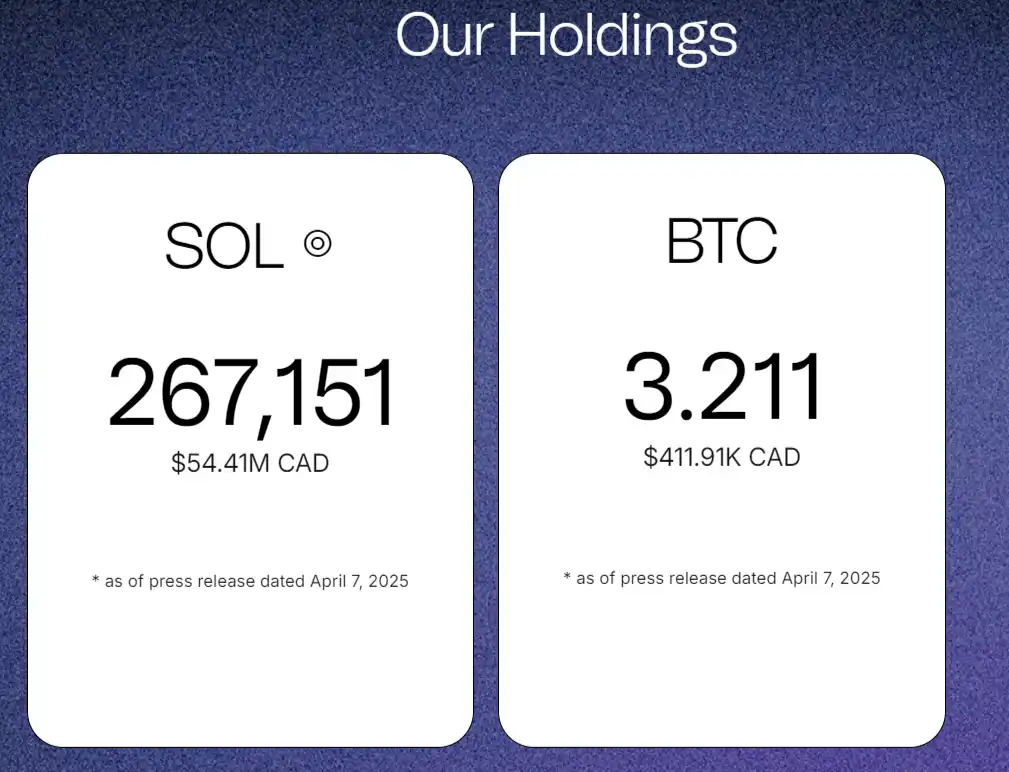
In addition to asset swapping, SOL Strategies has made significant progress and stable growth in validator node acquisition and revenue, as well as staking business:
Regarding validator node acquisition and growth, as of March 3, 2025, the company's validator nodes staked 1,653,752 SOL tokens, a 1434% increase from the end of 2024, with the company's own SOL tokens amounting to 239,607. These validator nodes are optimally designed for high scalability, high availability, and competitive staking rewards, ensuring operational efficiency;
Concerning staking business revenue growth, out of the 239,623 SOL tokens held by SOL Strategies, 239,607 tokens are specifically staked in its self-operated high-performance validator nodes, achieving a significant 137% increase from the staking amount of 101,200 tokens as of September 30, 2024. These staked SOL tokens generate an annual staking yield of 12,800 SOL, with an average annual staking reward rate of approximately 7% for validator nodes.
Regarding validator node revenue, starting from January 1, 2025 (the first day SOL Strategies took full control of the three major Solana validator nodes), the validator nodes achieved an annual revenue of 26,512 SOL. This income is derived from the commission generated by the SOL tokens delegated by the company and third parties to SOL Strategies' high-performance validator nodes.
Public Companies Rush to Invest, Is Spring Coming for Solana?
Perhaps influenced by Canada's approval of a staking-based SOL ETF, a large amount of funds flowed into the SOL ecosystem this week, and SOL Strategies is not the first company to implement a "SOL-version MicroStrategy."
On April 21, cryptocurrency trading and investment company GSR announced a lead investment of $100 million in equity financing into Nasdaq-listed company Upexi, Inc. Upexi is a brand owner focused on consumer product development, manufacturing, and distribution. This investment comes after Upexi announced a strategic shift to a cryptocurrency-based financial strategy, aiming to create long-term shareholder value and returns. Upexi has committed to implementing a Solana financial strategy, including increasing holdings and staking in Solana. Subsequently, Upexi's stock price surged by 659.91% to reach $17.25, reflecting the market's positive response to the Solana strategy.
In addition, on April 22nd local time, the DeFi Development Corporation (NASDAQ: JNVR) announced that it had purchased 88,164 SOL tokens, worth approximately $11.5 million. On April 23rd, it made another purchase of 65,305 SOL, worth $9.9 million, increasing the total holdings to 317,273 SOL, valued at $48.2 million.
Meanwhile, as the first and largest Solana-native public company in North America, SOL Strategies has bridged a broader path between traditional finance and blockchain innovation, providing investors with a scalable and compliant Solana ecosystem investment channel to continuously support the development and expansion of the Solana ecosystem.
SOL Strategies shares a strategic similarity with MicroStrategy. MicroStrategy holds a significant amount of Bitcoin as a core asset on its balance sheet, providing investors with an indirect route to invest in Bitcoin. Similarly, SOL Strategies, by holding SOL and operating validation nodes, has provided investors with an indirect opportunity to invest in Solana. Both have taken the form of publicly listed companies to offer traditional investors a way to access cryptocurrency.
However, SOL Strategies not only holds SOL but also actively participates in the Solana ecosystem, earning additional revenue through operating validation nodes and investing in Solana projects. Active engagement in the SOL ecosystem can, in turn, enhance the company's asset value. As stated by SOL Strategies CEO Leah Wald, SOL Strategies is the largest-scale funding mechanism in the Solana ecosystem, where each investment instantly generates returns, simultaneously boosting the company's assets and supporting the development of the validation node business.
Solana's printing press seems to be getting into gear as the SOL ETF is approved in Canada, expectations for the SOL ecosystem are improving, the meme sector is becoming more active, and traditional financial funds are pouring in. Whether it's the $500 million funding of SOL Strategies, GSR's $100 million investment in UPXI, or the DeFi Development Corporation purchasing over $20 million worth of SOL in two days, all indicate a broader development space for the Solana ecosystem in the future. When will the SOL ecosystem experience a renaissance? Let's wait and see.
You may also like

Morning Report | CoinEx becomes a key hub for Iran to evade sanctions, involving over $3.8 billion in funds; Kalshi seeks a new round of financing, with a valuation potentially rising to $40 billion

From the white-haired stock god to the billionaire fund mogul, the smart people shorting Nvidia are all getting rich using the same framework

Why do cryptocurrency projects always like to change their names?

Global Launch: As predictions become the most scarce asset in the AI era, Manadia is defining the next generation of the value internet

Who is footing the bill for the $64 billion accounting frenzy?
I never expected that the first application of AI x Crypto would be in security auditing

What is your view on Binance's competitive advantages?

ETH has entered a non-consensus phase, and the turning point is approaching!
The shift in the cloud of the air: from despising stablecoins a year ago to the high-profile entry of capital today
The survival dilemma of small and medium exchanges behind the withdrawal anomalies exposed by AscendEX

Why Is Bitcoin Falling Below $60K? 5 Key Market Drivers Explained
Bitcoin has dropped sharply amid ETF outflows, Strategy stock weakness, AI stock rallies, and changing Fed expectations. Explore the key forces driving BTC’s latest correction and what traders should watch next.

Bitcoin vs. Gold in 2026: Which Asset Performs Better in Different Markets?

Morning News | The draft amendment to the People's Bank of China Law aims to clarify the legal status of digital renminbi; South Korea will transfer about 40 unregistered virtual asset service providers to law enforcement agencies
The cryptocurrency industry has entered the "Show Me" era: merely relying on vision is no longer enough

Interpreting the Ethereum Foundation's new structure: Reaffirming self-sovereignty amid institutional trends
Former SpaceX engineer reconstructs the financial execution system using first principles
Standard Chartered Bank sings a 50x rhapsody again, aiming for AAVE to reach 3500 USD

Tidal Investment: We still have a positive outlook on the AI industry chain, but the reasons have changed
Morning Report | CoinEx becomes a key hub for Iran to evade sanctions, involving over $3.8 billion in funds; Kalshi seeks a new round of financing, with a valuation potentially rising to $40 billion
From the white-haired stock god to the billionaire fund mogul, the smart people shorting Nvidia are all getting rich using the same framework
Why do cryptocurrency projects always like to change their names?
Global Launch: As predictions become the most scarce asset in the AI era, Manadia is defining the next generation of the value internet
Who is footing the bill for the $64 billion accounting frenzy?
I never expected that the first application of AI x Crypto would be in security auditing


