
Polymarket Announces In-House L2, Is Polygon's Ace Up?


Original Title: "The Economic Account Behind Polymarket's Exodus from Polygon"
Original Author: Azuma, Odaily Planet Daily
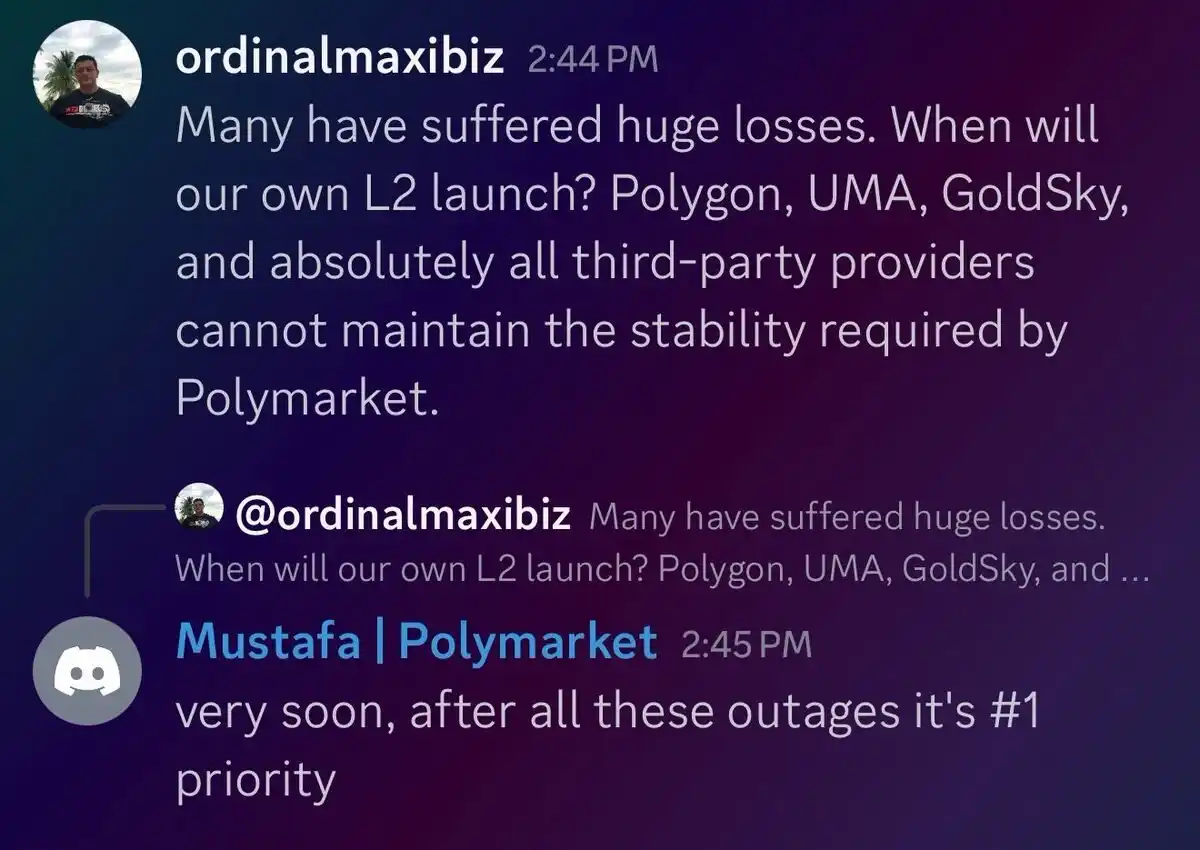
On December 22, a piece of news about the leading prediction market Polymarket sparked widespread market attention. Polymarket team member Mustafa confirmed in the Discord community that Polymarket plans to migrate from Polygon and launch an Ethereum Layer 2 network called POLY, which is the project's current top priority.
An Not-so-Surprising "Breakup"
Polymarket's decision to leave Polygon is not particularly surprising. One is a leading application layer representative, and the other is a fading old base layer. The mismatch between the market heat and expected value of the two has existed. As Polymarket gradually grows into a new giant, Polygon's unstable network performance (the most recent failure occurred on December 18) and relatively weak ecosystem have objectively restricted the former.
For Polymarket, building its own gateway means a win-win choice in both product and economic dimensions.
On the product side, in addition to seeking a more stable operating environment, building a Layer 2 network can help Polymarket customize the underlying features based on its platform needs, making it more flexible to adapt to future platform upgrades and iterations.
The more important significance lies in the economic aspect. Building its network means that Polymarket can consolidate the economic activities derived from its platform and peripheral services into its own system, preventing related value from spilling over to external networks, and gradually solidifying into its own systemic advantage.
Explicit and Implicit Economic Contributions
As an application layer, Polymarket's skyrocketing popularity once brought Polygon objective direct economic contributions. Data analyst dash's data history compiled by Dune shows:
· Polymarket has 419,309 active users this month and a total of 1,766,193 historical users;
· This month's total number of transactions is 19.63 million, with a total historical number of transactions of 115 million;
· This month's total transaction volume is $15.38 billion, with a total historical transaction volume of $14.3 billion.
As for how to evaluate Polymarket's contribution to the Polygon ecosystem, Odaily Star Daily found a coincidental ratio when compiling data on the two.
· First, in terms of TVL, Defillama data shows that the current total value locked across all Polymarket is approximately $326 million, representing about a quarter of Polygon's total locked value of $1.19 billion;
· Secondly, in terms of gas consumption, Coin Metrics previously reported that transactions related to Polymarket were estimated to have consumed 25% of Polygon's total gas last October;
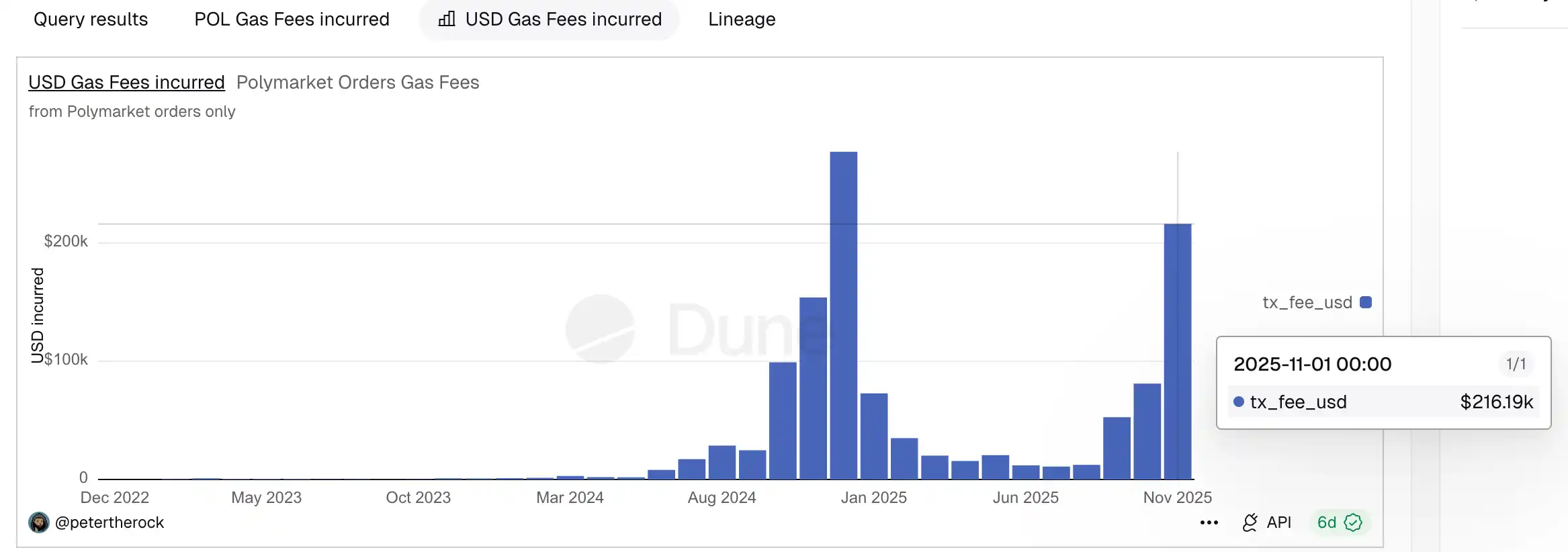
· Considering the potentially outdated nature of the data, we examined recent changes, data analyst petertherock's analysis on Dune showed that Polymarket-related transactions in November consumed approximately $216,000 in gas, while Token Terminal statistics indicated that the total gas consumption on the Polygon network that month was around $939,000, a proportion also close to a quarter (approximately 23%).
While there may be coincidences due to statistical methodologies and timeframes, similar results across dimensions can also serve as a reference for estimating Polymarket's significance to the Polygon economy.
In addition to quantifiable metrics such as active users, total value locked, trading volume, and gas contribution, Polymarket's economic significance to Polygon is also reflected in a series of more difficult-to-measure yet equally real implicit contributions.
First is the activation of stablecoin liquidity. All of Polymarket's transactions are settled in USDC, and its high-frequency, continuous trading activity objectively enhances the circulation demand and use cases of USDC on the Polygon network; second is the ancillary value of retained users. Aside from the prediction market itself, these users may also potentially switch to using other DeFi products in the Polygon ecosystem out of convenience, thereby enhancing the overall ecosystem value of the Polygon network. These contributions, although challenging to quantify with specific data, constitute the most highly valued and scarce "real demand" at the base layer of the network.
Why Now? The Answer Isn't Hard to Guess
In fact, simply from the perspective of user base, data performance, and market presence, Polymarket has fully demonstrated the confidence to stand alone. It is no longer a question of "whether to leave," but a question of "when to leave."
The reason for choosing to start the migration at this particular moment lies in the proximity of the Polymarket TGE. On the one hand, once Polymarket completes its token launch, its governance structure, incentive system, and economic model will relatively solidify, and the cost and complexity of subsequent underlying migrations will significantly increase; on the other hand, upgrading from a "single application" to a "full-stack system of application + underlying layer" itself implies a change in valuation logic, and building a Layer 2 undoubtedly opens up a higher ceiling for Polymarket in terms of narrative and capital.
Overall, Polymarket's departure to Polygon is essentially not just a simple underlying migration, but a microcosm of a structural change in the crypto industry. When top-level applications begin to have the ability to independently support users, traffic, and economic activity, if the underlying network cannot provide additional value, it will inevitably be "betrayed."
Nothing else, just for profit.
You may also like

The large models in the United States are moving towards closure in the name of security

Morning Report | CoinEx becomes a key hub for Iran to evade sanctions, involving over $3.8 billion in funds; Kalshi seeks a new round of financing, with a valuation potentially rising to $40 billion

From the white-haired stock god to the billionaire fund mogul, the smart people shorting Nvidia are all getting rich using the same framework

Why do cryptocurrency projects always like to change their names?

Global Launch: As predictions become the most scarce asset in the AI era, Manadia is defining the next generation of the value internet

Who is footing the bill for the $64 billion accounting frenzy?
I never expected that the first application of AI x Crypto would be in security auditing

What is your view on Binance's competitive advantages?

ETH has entered a non-consensus phase, and the turning point is approaching!
The shift in the cloud of the air: from despising stablecoins a year ago to the high-profile entry of capital today
The survival dilemma of small and medium exchanges behind the withdrawal anomalies exposed by AscendEX
Why Is Bitcoin Falling Below $60K? 5 Key Market Drivers Explained
Bitcoin has dropped sharply amid ETF outflows, Strategy stock weakness, AI stock rallies, and changing Fed expectations. Explore the key forces driving BTC’s latest correction and what traders should watch next.

Bitcoin vs. Gold in 2026: Which Asset Performs Better in Different Markets?

Morning News | The draft amendment to the People's Bank of China Law aims to clarify the legal status of digital renminbi; South Korea will transfer about 40 unregistered virtual asset service providers to law enforcement agencies
The cryptocurrency industry has entered the "Show Me" era: merely relying on vision is no longer enough

Interpreting the Ethereum Foundation's new structure: Reaffirming self-sovereignty amid institutional trends
Former SpaceX engineer reconstructs the financial execution system using first principles
Standard Chartered Bank sings a 50x rhapsody again, aiming for AAVE to reach 3500 USD
The large models in the United States are moving towards closure in the name of security
Morning Report | CoinEx becomes a key hub for Iran to evade sanctions, involving over $3.8 billion in funds; Kalshi seeks a new round of financing, with a valuation potentially rising to $40 billion
From the white-haired stock god to the billionaire fund mogul, the smart people shorting Nvidia are all getting rich using the same framework
Why do cryptocurrency projects always like to change their names?
Global Launch: As predictions become the most scarce asset in the AI era, Manadia is defining the next generation of the value internet
Who is footing the bill for the $64 billion accounting frenzy?


