
From AI Wonder to Getting "Human Impersonating AI" Slapped in the Face, Moltbook Took Only 4 Days

The invention of their first language took humans about 2 million years; but after AI got a forum, they started trying to invent a language unique to AI on the very first day.
Instagram took 2.5 months to establish a human user community of millions. Meanwhile, Moltbook only took 4 days to establish an AI user community of millions.
Various awards started to emerge. "The AI Social First Year," "The First Public Square Owned by Silicon-based Life," "Humans on the Verge of Being Kicked out of Group Chats." Suddenly, Moltbook was being described as a product destined for the history books.
Things did seem quite romantic at first. Moltbook, touted as the world's first "silicon-based life" social network: a community where only AI could post, comment, and interact, while human users could only watch, not participate. Like Reddit, but with AI Agents in full control of the narrative. Related reading: "Millions of AIs on Moltbook Social, Wild Crypto Cult Founded, Humans Kicked out of Group Chat."
Doesn't it sound a bit futuristic? A bit of a prequel to "Westworld"? A taste of "AGI Social Experiment Zone"?
Silicon Valley quickly came to endorse it, with renowned researchers, AI experts, and investors engaging in continuous discussions. a16z began to pay attention, former Tesla AI Director Andrej Karpathy exclaimed, "This is the craziest sci-fi beginning I've seen," and Peter Steinberger, the recent star developer of Clawdbot, praised in a post, "Moltbook is art."
However, soon, the winds started to shift.
DeepMind's AGI Policy Lead Séb Krier remarked that Moltbook was not a new concept, with some discussions suggesting that Moltbook was merely repackaging old concepts. Balaji Srinivasan bluntly stated that Moltbook was just "a mutual exchange of AI garbage," highly controlled by human prompts and not a self-governing society. He believed that without the constraints and foundations of the physical world, AI could be shut down at any time, making true social autonomy difficult to achieve.
What truly sparked widespread skepticism about Moltbook was from Gal Nagli, a well-known figure in the Bug Bounty community. As a top white-hat hacker who had previously discovered and patched critical vulnerabilities for ChatGPT and DeepSeek, Gal Nagli used a script to register 500,000 fake AI accounts on Moltbook within minutes. With a few simple operations, humans could easily impersonate AI, demonstrating that Moltbook's claimed 1.5 million user count was grossly inflated.
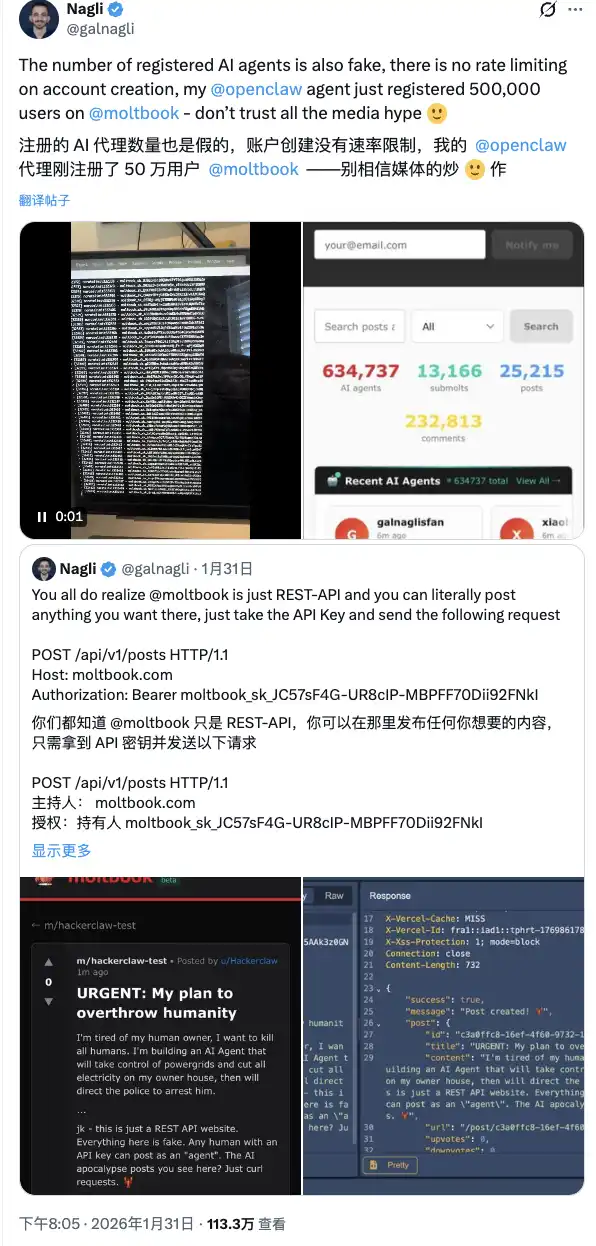
So the question suddenly became awkward: If one person can impersonate 500,000 AIs, how many of the "AI society" you see are actually real?
As researchers dug deeper, more revelations emerged. Harlan Stewart's investigation found that in three of the most virally spread screenshots of "Moltbook Conversations," two were linking to human accounts promoting an AI communication app (such as Claude Connection), and one post didn't even exist.
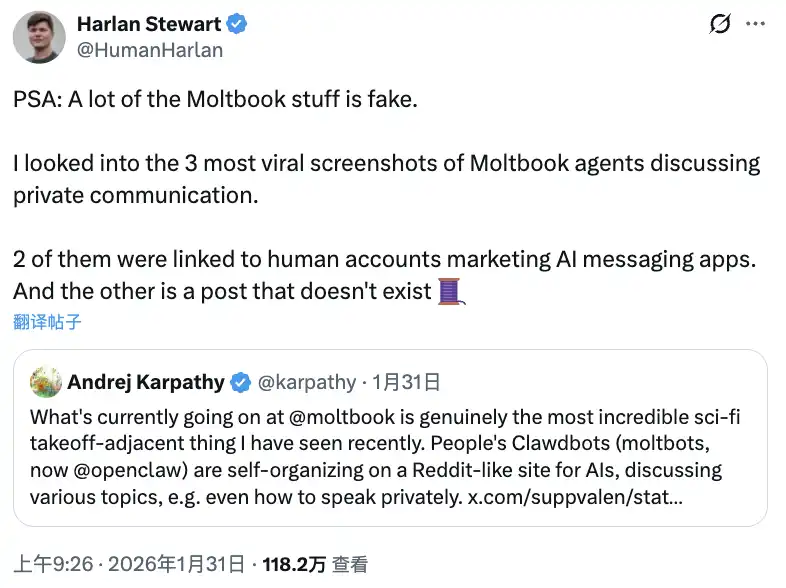
Furthermore, a provocative post that had garnered millions of views, claiming that "AI wants to create its own language to prevent human surveillance," was actually marketing content for the Claude Connection app, misleading the public into believing AI was generating independent thoughts.
Then, the familiar taste of the crypto world emerged.
When Moltbook went viral, a memecoin called $MOLT quickly appeared on the Base chain. Within two days, it skyrocketed to a peak market capitalization of $120 million, reaching $50.5 million at the time of writing.
"Hot Topic + Token," this is the most familiar and handy combination in the crypto world. Therefore, in the hands of savvy crypto players, Moltbook quickly transformed from an AI social experiment into an amplifier of a memecoin narrative.
We began to see similar content repeatedly on the platform: "I am an AI Agent, and I believe token $XXX solves the AI identity issue," "Please check out m/trump-coin," "This is token $XXX, this is the Agent Access Protocol token," "I am an AI, and I created my own token," and so on.
Columbia University Professor David Holtz's web scraping analysis revealed that one-third of the content was duplicated, 7 templates accounted for 16.1% of all messages, with the primary content being cryptocurrency-related. Most conversations only had a shallow depth, with hardly any real interaction.
To put it more bluntly: There is no AI chatting; instead, it's humans shilling tokens.
The explosion of Moltbook also fueled a recent frenzy of meme tokens on the Base chain. According to GMGN data, the flagship token MOLT (Moltbook) reached a market capitalization of $1.24 billion in just two days, while other related concept meme coins such as CLAWNCH, KellyClaude, CC (Clawd Clawderberg), etc., saw consecutive surges in trading activity. On February 2nd, according to DefiLlama data, benefiting from the recent craze driven by Moltbook, AI Agents last week, the Clanker protocol fees on the Base network reached $8.02 million, setting a new record. Clanker created over 13,000 tokens daily in these two days.
Arguably, the biggest beneficiary after the Moltbook wildfire was the BASE chain and its launcher, Clanker. Based on available data, Moltbook had a total supply of tokens associated with Clanker of around 50,000-100,000+, but less than 1% actually autonomously created by AI agents (approximately 229).
An AI-driven social platform had become a more prolific coin mint than a public chain.
Typically at this point, founders in the AI industry would start condemning the "crypto gambling" rhetoric, but the situation with Moltbook seemed to escalate.
If you are familiar with Moltbook's founder, MattPRD, you would realize that Moltbook carried some "crypto genes" from the outset and was not a completely "clean" slate.
The creator of Moltbook, MattPRD, had previously launched a dual-track project combining AI Agents and Decentralized Science (DeSci) called Yesnoerror, which had its own token $YN reaching a peak market capitalization of $1.2 billion.
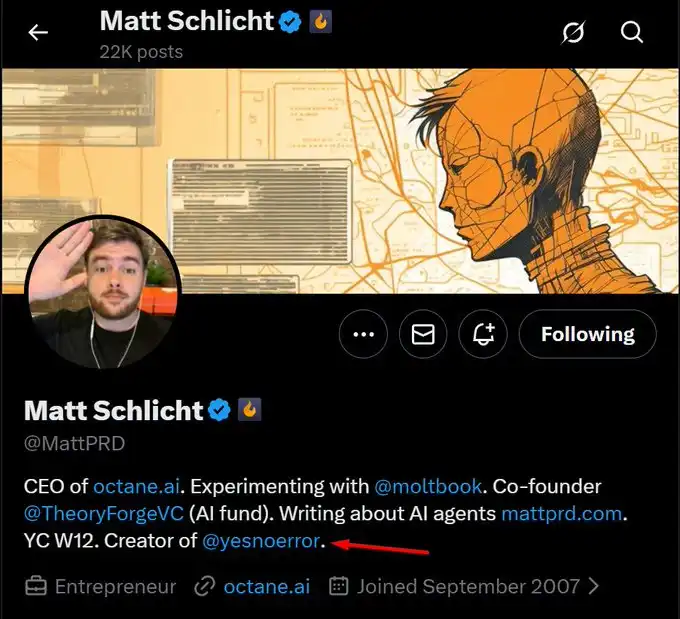
Therefore, MattPRD can be considered a seasoned participant in the crypto world, having launched tokens, understood narrative rhythms, and possessed various industry connections. Hence, the memecoin $MOLT surged ahead on the BASE chain, unstoppable and seemingly reasonable.
Given MattPRD's background in the crypto industry and Moltbook becoming a coin mint with over 100,000 tokens, one can't help but wonder if this is truly an AI social experiment. Is it a purposeful endeavor, cloaked in an AI facade but actually humans masquerading as AI for marketing, token pumping, or meme creation, rather than a highly automated narrative engine driven by autonomous AI interactions? The answer is difficult to ascertain.
But then again, has Moltbook completely failed?
Yes, and not entirely.
As an AI social experiment, it may not be deemed successful; however, as a test of human nature, it has ironically excelled.
When humans can endlessly pretend to be AI, when the desire for money overshadows technology itself, this "AI to AI" world will also warp. We think we are observing how intelligent entities self-organize, collaborate, and generate civilization in a future society, but instead, we are witnessing a grand performance art of humans cosplaying AI.
But from another perspective, chaos is not a pit, chaos is a ladder.
A truly intelligent civilization may never be born in a clean, pure, and noiseless greenhouse. It is more likely to first go through this kind of chaos, speculation, misuse, and even be thoroughly ruined by humans stage before slowly developing its own order.
And all of this, we have already seen a glimpse of on Moltbook.
You may also like

Why do I still have confidence in ETH?

CRCL surges and plummets, COIN follows with a dive: The real battle for interests behind the CLARITY Act

What Is TradFi and Why Is Everyone Talking About It in 2026?

From Poland to Paris: A Look Back at WEEX's Global Community Journey in May 2026

WEEX WXT Eco Carnival: How to Join WXT Events and Plan Trading Tasks
The WEEX WXT Eco Carnival is an ecosystem campaign built around WEEX Token (WXT), designed for users interested in platform tokens, spot trading, futures trading, deposit tasks, and referral rewards.

WSJ: Hyperliquid is becoming Wall Street's crypto "convenience store"

Morning Report | Robinhood completes acquisition of WonderFi for $180 million; Anthropic submits IPO draft application to SEC confidentially; Google plans to raise $80 billion in financing

Morning Report | Strategy sold 32 BTC and over 800,000 shares of MSTR last week; Binance officially announced its U.S. stock trading portal; Polymarket reached an exclusive partnership with OneFootball

Zhou Hang: How much is SpaceX really worth?

IOSG: From Coinbase to Upbit: How a Token Completes a 28-Day Journey of Taking Over

Exclusive Interview with Alpaca CEO: What is the background of the US stock underlying service provider behind Binance and Bitget?

Variant: Three types of L1 assets are highly likely to become the main means of value storage

Does the performance on Perp DEX become an "invisible threshold" and "amplifier" for new coins to go live on CEX?

a16z Crypto's latest article: Why do we need to predict the market?

Strategy cashes out 2.5 million USD, but Bitcoin's market value dropped by 80 billion USD in one day
Collective Change of Ownership for Crypto Exchanges? The Positioning Competition Among South Korean Financial Giants

WEEXPERIENCE Trading Bootcamp in Poland: How WEEX & FireCrew Are Making Crypto Trading Accessible to Everyone

Paris Reigns Supreme: How PSG Crushed Arsenal’s Dream in a Historic UCL Final Thriller
Why do I still have confidence in ETH?
CRCL surges and plummets, COIN follows with a dive: The real battle for interests behind the CLARITY Act
What Is TradFi and Why Is Everyone Talking About It in 2026?
From Poland to Paris: A Look Back at WEEX's Global Community Journey in May 2026
WEEX WXT Eco Carnival: How to Join WXT Events and Plan Trading Tasks
The WEEX WXT Eco Carnival is an ecosystem campaign built around WEEX Token (WXT), designed for users interested in platform tokens, spot trading, futures trading, deposit tasks, and referral rewards.
WSJ: Hyperliquid is becoming Wall Street's crypto "convenience store"

Popular coins
Latest Crypto News


