
Cryptocurrency Market Experiencing "Choppy Accumulation": XRP Bandwidth Indicator Dips Below Annual Threshold, Whale Holdings Movement Suggests Shift in Market Direction



Original Title: XRP Resembles a Compressed Spring Poised for a Significant Price Move as Key Volatility Indicator Mirrors 2024 Patterns
Original Author: Omkar Godbole
Original Translation: Daisy, Mars Finance
XRP resembles a compressed spring, ready for a significant price move, as a key volatility indicator mirrors patterns from 2024. A technical indicator based on standard deviation suggests XRP and BTC may be in for another round of intense volatility.
Key Points:
The price action of XRP and Bitcoin appears like a compressed spring, signaling a potential major price swing. The Bollinger Bandwidth of these two cryptocurrencies has dropped to the lowest level since October 2024, indicating a buildup of market energy. While a contracting Bollinger Band may suggest an uptrend, it could also precede a sell-off, as seen after the FTX crash in October 2022.
The price trajectories of XRP and Bitcoin (BTC) resemble a tightly compressed spring that could unleash energy and see a rebound at any moment.
This signal comes from a key volatility indicator—the Bollinger Bandwidth. Bollinger Bands are volatility ranges set based on an asset's 20-period moving average (SMA) with an upper and lower boundary of two standard deviations (±2σ). The bandwidth measures the space between these ranges as a percentage of the 20-day moving average.
On XRP's 4-hour candlestick chart (each candle representing 4 hours of price action), the Bollinger Bandwidth has narrowed to the lowest level since October 2024. The 4-hour candlestick is popular in the 24/7 cryptocurrency market, with traders often using it to analyze and predict short-term price movements. Bitcoin's 4-hour candlestick chart also shows a similar Bollinger Bandwidth pattern to XRP.
The long-standing market consensus is that a narrowing Bollinger Bandwidth (reflecting a period of market calm) is like a compressed spring, often signaling a significant market movement on the horizon.
During these periods of market calm, energy continues to accumulate, and once the direction is clear, it will be released dramatically, often leading to a sharp price increase or decrease. The sharp rise of XRP and Bitcoin in November to December 2023 occurred after a long period of sideways movement, with the Bollinger Bands narrowing to a level similar to the current one.
However, narrowing of the bands does not always signal a bullish trend; it can also precede a sell-off. For example, in October 2022, the Bollinger Bands narrowing foretold a significant volatility, and the subsequent FTX collapse caused a steep market decline.
It is currently uncertain whether this "spring compression" will trigger a bullish move or lead to a downward spiral for these two tokens. Federal Reserve Chairman Jerome Powell's recent hawkish comments and the sell-off behavior of some whales lean more towards the latter.
Stay vigilant!
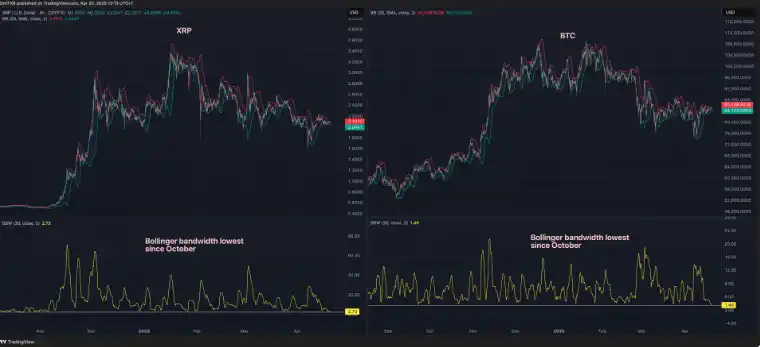
XRP and BTC with Bollinger bandwidth. (TradingView/CoinDesk)
You may also like

Morning Report | CoinEx becomes a key hub for Iran to evade sanctions, involving over $3.8 billion in funds; Kalshi seeks a new round of financing, with a valuation potentially rising to $40 billion

Why do cryptocurrency projects always like to change their names?

From the white-haired stock god to the billionaire fund mogul, the smart people shorting Nvidia are all getting rich using the same framework

Morning News | The draft amendment to the People's Bank of China Law aims to clarify the legal status of digital renminbi; South Korea will transfer about 40 unregistered virtual asset service providers to law enforcement agencies

The cryptocurrency industry has entered the "Show Me" era: merely relying on vision is no longer enough
Interpreting the Ethereum Foundation's new structure: Reaffirming self-sovereignty amid institutional trends
Former SpaceX engineer reconstructs the financial execution system using first principles

Tidal Investment: We still have a positive outlook on the AI industry chain, but the reasons have changed

Standard Chartered Bank sings a 50x rhapsody again, aiming for AAVE to reach 3500 USD

The interim executive director of the Ethereum Foundation speaks out: What is our mission?
Why does OKX want to start a new company with the parent company of the New York Stock Exchange?

Why Is PAXG Price Different From Gold? 5 Reasons Crypto Traders Should Know

WEEX OpenAPI 101: 5 Powerful Modules, AI Trading Tools, and Grab Up to 70% Revenue Opportunities
Learn how WEEX OpenAPI connects traders, developers, AI agents, and trading platforms. Discover WEEX API features, Binance-compatible integration, automated trading workflows, revenue opportunities, and ecosystem possibilities.

Interview with NDV Founder Jason Huang: Popping the AI Bubble and the Myth of Microstrategy, Seeking the Ultimate Ace in the Crypto Market

Morning Report | Former Ethereum Foundation researcher establishes Ethlabs; EU Parliament Economic Committee passes digital euro regulatory proposal

Dragonfly partner Haseeb: The fastest-growing companies in the future may all be stuck at 149 people

How xBubble Breaks the Deadlock in VC's Heavy Investment in the OPC Economy

The encrypted unicorn Blockstream is deeply embroiled in a serious fraud case
Morning Report | CoinEx becomes a key hub for Iran to evade sanctions, involving over $3.8 billion in funds; Kalshi seeks a new round of financing, with a valuation potentially rising to $40 billion
Why do cryptocurrency projects always like to change their names?
From the white-haired stock god to the billionaire fund mogul, the smart people shorting Nvidia are all getting rich using the same framework
Morning News | The draft amendment to the People's Bank of China Law aims to clarify the legal status of digital renminbi; South Korea will transfer about 40 unregistered virtual asset service providers to law enforcement agencies
The cryptocurrency industry has entered the "Show Me" era: merely relying on vision is no longer enough
Interpreting the Ethereum Foundation's new structure: Reaffirming self-sovereignty amid institutional trends


