
8 Shitcoin ETFs Entry Record: Only $700 Million Raised, Unable to Stop Price Decline




Original Article Title: "Observation of Four Major Altcoin ETFs Listing: Total Inflow of $700 Million, Issuance Easy but Difficulty in Attracting Funds"
Original Author: Nancy, PANews
As the US SEC opens a fast track for crypto ETFs and the regulatory environment becomes increasingly clear, more and more altcoins are attempting to step onto the Wall Street stage. Since last month, 8 altcoin ETFs have been approved one after another, but in the overall bearish crypto market environment, these products are generally facing the problem of limited fund inflow after listing, making it difficult to significantly boost the coin prices in the short term.
Four Major Altcoins Landing on Wall Street, Limited Short-Term Fundraising Capability
Currently, four crypto projects, Solana, Ripple, Litecoin, and Hedera, have obtained the "ticket" to Wall Street. However, from the perspective of fund flows, the overall attractiveness is still limited, and some ETFs have experienced zero inflows for multiple days. These four types of ETFs have only received a cumulative net inflow of approximately $700 million. Additionally, after the ETFs were launched, the prices of the respective coins have generally declined, which is also partly influenced by the overall crypto market pullback.
• Solana
Currently, there are five US Solana spot ETFs on the market, issued by Bitwise, VanEck, Fidelity, Grayscale, and Canary, with related products from 21Shares and CoinShares also in the pipeline.
According to SoSoValue data, the cumulative total net inflow of US Solana spot ETFs is approximately $420 million, with a total net asset value of $594 million. Among them, Bitwise's BSOL contributed the main trading volume, with a total of $388 million in net inflow over three weeks, but most of it came from an initial investment of nearly $230 million on the first day, after which the inflow slowed significantly. Fidelity's FSOL had a net inflow of only $2.07 million on the first day of listing on November 18, with a total net asset value of $5.38 million; Grayscale's GSOL had a cumulative net inflow of approximately $28.45 million, with a total net asset value of $99.97 million; Canary's SOLC had no net inflow on the first day of listing, with a total net asset value of $0.82 million. It is worth noting that the ETF issuers all support staking, which may provide some support for market demand.
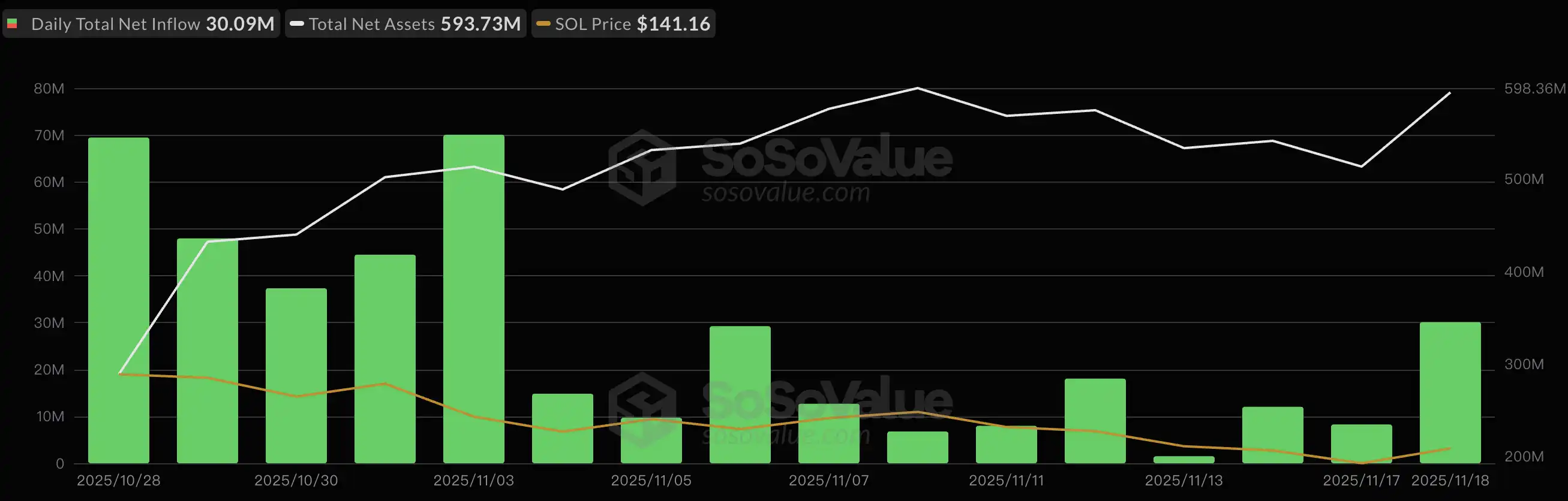
CoinGecko data shows that since the first Solana spot ETF went live on October 28, the price of SOL has dropped by 31.34% to date.
• XRP
Regarding the U.S. XRP spot ETF, the only product currently listed is XRPC launched by Canary. Related products from CoinShares, WisdomTree, Bitwise, and 21Shares are still in the preparation stage.
According to SoSoValue data, since its launch, XRPC has seen a cumulative net inflow of over $270 million. The first-day trading volume reached $59.22 million but did not generate net inflows. The next day, net inflows of $243 million were achieved through cash or in-kind purchases, with a trading volume of $26.72 million.
CoinGecko data shows that since the first Ripple spot ETF was listed on November 13, the XRP price has dropped by approximately 12.71%.
• LTC
At the end of October this year, Canary Capital officially launched the first U.S. ETF tracking Litecoin, LTCC. Related products from CoinShares and Grayscale are still in the preparation stage and are expected to follow suit.
According to SoSoValue data, as of November 18, LTCC has seen a cumulative net inflow of approximately $7.26 million. Daily net inflows are generally only in the hundreds of thousands of dollars, with several days experiencing zero inflows.
CoinGecko data shows that since the first Litecoin spot ETF was listed on October 28, the LTC price has dropped by about 7.4%.
• HBAR
The first U.S. ETF tracking HBAR, HBR, was also launched by Canary Capital at the end of last month. According to SoSoValue data, as of November 18, HBR has seen a cumulative net inflow of approximately $74.71 million. Nearly 60% of the funds were concentrated in the first week of inflows, after which net inflows decreased significantly, with some days even experiencing consecutive days of zero inflows.
CoinGecko data shows that since the first Hedera spot ETF was listed on October 28, the HBAR price has dropped by approximately 25.84%.
In addition to the above projects, upcoming spot ETFs for assets such as DOGE, ADA, INJ, AVAX, BONK, and LINK are still in progress. Bloomberg analyst Eric Balchunas expects Grayscale's Dogecoin ETF to be launched on November 24.
Crypto ETF Expansion Cycle Initiated, Listing Performance Still Faces Multiple Challenges
According to Bloomberg's incomplete statistics, the crypto market currently has 155 ETP (Exchange-Traded Product) applications, covering 35 digital assets, including Bitcoin, Ethereum, Solana, XRP, and LTC, presenting a beachhead-style growth trend. With the end of the U.S. government shutdown, the approval process for these ETFs is expected to accelerate.
As the U.S. regulatory environment gradually clarifies, it may propel a new round of expansion for crypto ETF applications. The U.S. SEC has approved general listing standards for crypto ETFs and recently released new guidance allowing ETF issuers to expedite the effectiveness of their registration statements. Meanwhile, in its latest annual examination priorities document, the U.S. SEC significantly removed the previously routine cryptocurrency-specific section. This is in contrast to the era of former chair Gary Gensler when cryptocurrencies were explicitly included as an examination priority, specifically mentioning spot Bitcoin and Ethereum ETFs.
Furthermore, the introduction of staking is believed to stimulate institutional investor demand, thus attracting more issuers to join the ETF application queue. Research from Swiss crypto bank Sygnum shows that despite the recent market downturn, institutional investor confidence in crypto assets remains strong. Over 80% of institutions express interest in crypto ETFs beyond Bitcoin and Ethereum, with 70% stating that if an ETF can offer staking rewards, they would begin or increase their investments. On the policy front, there has also been a positive signal for ETF staking. Recently, U.S. Treasury Secretary Scott Bessent issued a new statement saying they will collaborate with the IRS to update guidance to provide regulatory support for crypto ETPs that include staking capabilities. This move is considered likely to expedite the approval time for Ethereum staking ETPs and pave the way for multi-chain staking products on networks such as Solana, Avalanche, and Cosmos.
However, altcoin ETFs currently lack sufficient funding attractiveness, mainly due to factors such as market size, liquidity, volatility, and market sentiment.
On one hand, altcoins have limited market size and liquidity. According to CoinGecko data as of November 18, Bitcoin's market dominance is close to sixty percent, and after excluding ETH and stablecoins, the market share of other altcoins is only 19.88%. This makes the underlying asset liquidity of altcoin ETFs relatively poor. Additionally, compared to Bitcoin and Ethereum, altcoins are susceptible to short-term narratives, have higher volatility, and are seen as high-risk beta assets. Based on Glassnode data, since the beginning of this year, relative altcoin profits have mostly fallen to deep plunge levels, leading to a significant divergence between Bitcoin and altcoins not commonly seen in previous cycles. Thus, altcoin ETFs struggle to attract investors on a large scale, especially single-asset ETFs. In the future, investors may be more inclined to adopt diversified, decentralized basket altcoin ETF strategies to reduce risk and enhance potential returns.
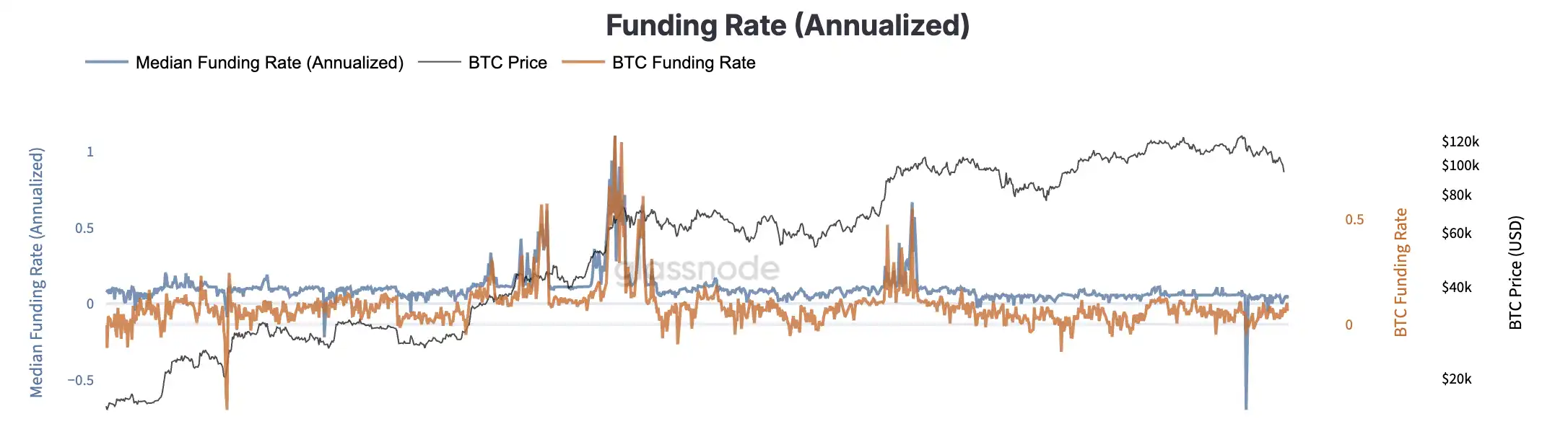
On the other hand, meme coins face market manipulation and transparency risks. Many meme coins have low liquidity, making them susceptible to price manipulation. The net asset value (NAV) of an ETF relies on the underlying asset price, so if a meme coin's price is manipulated, it directly affects the ETF's value, potentially triggering legal risks or regulatory scrutiny. Additionally, some meme coins may be deemed unregistered securities. Currently, the SEC is advancing a token taxonomy plan to differentiate whether a cryptocurrency qualifies as a security.
Furthermore, the uncertainty in the macroeconomic environment has exacerbated investors' risk aversion sentiment. In a situation of overall low confidence, investors tend to prefer allocating to traditional assets like US stocks and gold. Meanwhile, meme coin ETFs lack the recognition and market acceptance enjoyed by Bitcoin or Ethereum spot ETFs, especially lacking endorsement from major institutions like BlackRock. The distribution network, brand effect, and market trust brought by the top issuers are hard to replicate, further weakening the meme coin ETFs' attractiveness in the current environment.
You may also like

Circle CEO responds to OUSD's challenge: Stablecoins are a winner-takes-all business, and we will not slow down
Argentina vs Cape Verde: When a Record-Breaking Legend Meets an Unbreakable Underdog
WEEX exclusive pre-match analysis of Argentina vs Cape Verde, exploring Messi-led Argentina’s dominance and Cape Verde’s historic defensive breakout, with a breakdown of volatility, structure, and match dynamics.
How does Gate redo "buying and selling stocks" from the cryptocurrency world to the stock market?
Former ByteDance employee's account: How I started with two Pinduoduo hard drives and made six times the profit with Seagate to achieve financial freedom?
Visa and Mastercard join 140 giants to launch a new stablecoin, but the impact on the market landscape may still be limited
WEEX Launches Depth Chart for Spot Trading
MiCA reshuffle begins, Binance temporarily bids farewell to the EU
Raising interest rates to protect STRC and selling coins to maintain credit, this time the strategy has chosen the two most expensive paths
Morning Report | Samsung announces a 265.5 trillion won investment plan, focusing on semiconductor and AI computing power data centers; Vitalik publishes an article detailing the entire technology tree behind the confusion protocol (iO) mainline
In the era of AI, what is left of Bitcoin?
NeoSoul announced plans to integrate with the OKX Agentic Wallet, promoting AI agents' participation in the on-chain economy
Why Is Bitcoin Lagging Stocks in 2026? AI Stocks, ETF Outflows, and the Nasdaq Rally Explained
What you bought on CEX is really not US stocks: Analyzing the 94% liquidation monopoly and the evaporation of equity under a five-layer pipeline
In such a crowded cross-border payment arena, where is the next stop for the future?
Why Is Bitcoin Down in 2026? What We Can Learn From 2022
The large models in the United States are moving towards closure in the name of security
From the white-haired stock god to the billionaire fund mogul, the smart people shorting Nvidia are all getting rich using the same framework
Morning Report | CoinEx becomes a key hub for Iran to evade sanctions, involving over $3.8 billion in funds; Kalshi seeks a new round of financing, with a valuation potentially rising to $40 billion
Circle CEO responds to OUSD's challenge: Stablecoins are a winner-takes-all business, and we will not slow down
Argentina vs Cape Verde: When a Record-Breaking Legend Meets an Unbreakable Underdog
WEEX exclusive pre-match analysis of Argentina vs Cape Verde, exploring Messi-led Argentina’s dominance and Cape Verde’s historic defensive breakout, with a breakdown of volatility, structure, and match dynamics.
How does Gate redo "buying and selling stocks" from the cryptocurrency world to the stock market?
Former ByteDance employee's account: How I started with two Pinduoduo hard drives and made six times the profit with Seagate to achieve financial freedom?
Visa and Mastercard join 140 giants to launch a new stablecoin, but the impact on the market landscape may still be limited
WEEX Launches Depth Chart for Spot Trading